Caring and Safeguarding
Some people are less able to protect themselves from harm and are therefore at risk of abuse and/or neglect. Safeguarding is a communal agreement to protect these more vulnerable people and their carers, so they can live well and independently without fear.
Locally, the safeguarding of vulnerable adults is the concern of the Plymouth Safeguarding Adults Board and its partner agencies (including Police, Social Care and Health Services).
The Plymouth Safeguarding Adults Board recognises the vital role carers have in the adult safeguarding, and that the vast majority of carers strive to always act in the best interests of the person they support.
There are times, however, when carers are themselves experiencing abuse, either from the person to whom they are offering care or those within their local community. Sometimes due to stress, exhaustion, lack of information, or proper support, there is a risk that the carer may be doing unintended harm to the person they are caring for. Sadly, of course, there are also times when the harm is intended.
If you want support raising a safeguarding concern, either for yourself or someone you
know, please reach out and ask for help.
It’s not always easy to identify situations in which safeguarding may be a bigger concern, intentionally or unintentionally. Here are some questions you can ask yourself, or the person in question, to help clarify how urgent a concern feels.
Remember, it is always important to frame these questions compassionately and sensitively to avoid causing further distress:
- Are you vulnerable, or at risk yourself?
- Do you have unmet or unrecognised needs of your own?
- Are you not sure about the cared-for person’s specific needs or condition?
- Have you been forced to significantly change your lifestyle?
- Are you receiving any practical or emotional support from other friends or family members?
- Are you regularly feeling emotionally and socially isolated?
- Are you able to maintain other responsibilities, such as family or work?
- Do you get any personal time?
- Have you asked for help before, but problems haven’t gone away?
- Are you concerned about how the person you care for treats you?
- Do you feel unappreciated or unsupported?
If after these questions you want to talk to someone start by calling 01752 668000 or visit www.plymouth.gov.uk/reportadultabuseorneglect. Feel free to reach out for support or signposting.
Carers Rights
It’s important that you understand your rights as a carer, so that you are aware of the full range of support that is available to you if needed.
Our Carers Rights Information Pack: A full guide covering financial support, employment rights, healthcare entitlements, and legal protections. Whether you need help navigating benefits, workplace flexibility, or hospital discharge procedures, this resource helps empowers you with the knowledge to access the support you deserve.
The links below should also provide you with a lot of useful information.
The Carers UK Looking After Someone Guide: For anyone who cares for family or friends. This guide outlines your rights as a carer and gives an overview of the practical and financial support available.
Being Heard – a Guide to Self-advocacy for Carers: Another Carers UK resource, designed to help carers speak up for themselves and the person they care for.
Our advice service also offers free information and guidance on a range of topics. To speak to someone who will assess your advice needs, please click here.
Caring and Work
Many people take on the role of carer whilst also juggling part-time or full-time work, which can be especially challenging.
The following national websites offer information about finding the balance, alongside a few tips for talking to employers about flexible working, or taking time off when needed:
More links about caring and work are on our Local and national links page.
Flexible Working
You can also find a wide range of employment advice at this Carers UK resource, including flexible working rights, holiday entitlement, and what to do if an employer challenges these.
Once you feel you understand your flexible working rights, you can download a template of a flexible working application here.
Free Legal Guidance from Wolferstans
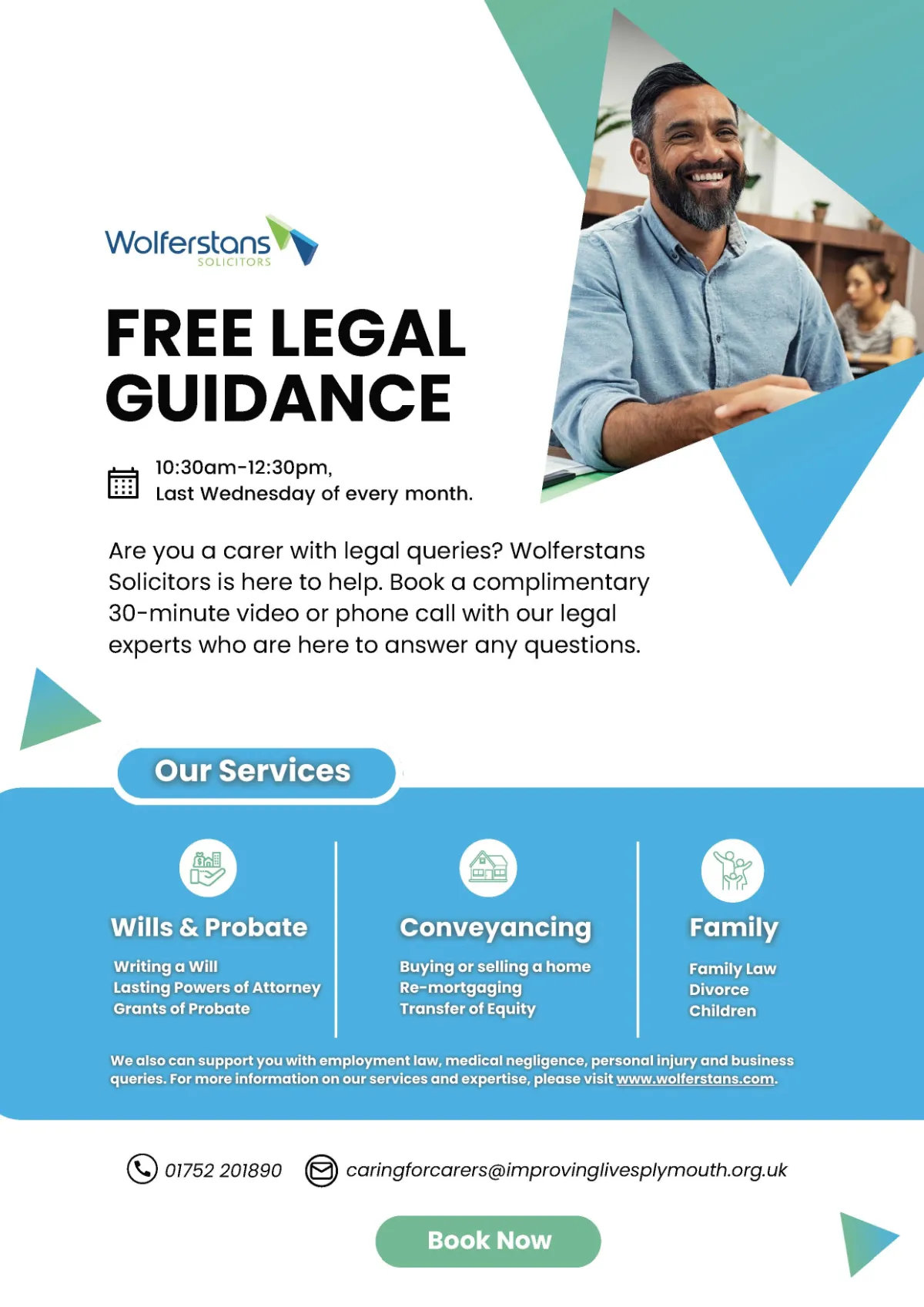
Wolferstans Solicitors offer carers a free 30-minute video or phone legal consultation, 10:30am to 12:30pm on the last Wednesday of every month.
Advice is available on:
- Wills & Probate – writing a will, Lasting Powers of Attorney, grants of probate
- Conveyancing – buying or selling a home, re-mortgaging, transfer of equity
- Family – family law, divorce, children
Employment law, medical negligence, personal injury and business queries can also be discussed.
To book your consultation, call 01752 201890 or get in touch with the Caring for Carers team.
Carers Emergency Response Service (CERS)
From time to time, we encounter situations that we perhaps don’t expect. If you are the main carer for someone, when such difficulties happen not only do you have to think about yourself, you also need to think about them.
The Carers Emergency Response Service (CERS) will provide you with the reassurance that should you experience a difficult time and cannot provide care yourself, your loved one will be well looked after in their own home environment.
In Plymouth, the Carers Emergency Response Service is operated by J&C Healthcare.
They can help with:
- washing and dressing
- helping get in and out of bed
- preparing meals and drinks
- medication management
- companionship
- light cleaning and shopping
For carers wanting to register with the service, please contact J&C healthcare on 07474 297040 or 01752 424138.
If you are a professional wanting to refer an unpaid carer, please use this link: Carers Emergency Response – J&C Healthcare Ltd and complete the CERS form.
If you require any further information please contact the service either via telephone 07474 297040 or 01752 424138 or email: cers@jchealthcare.co.uk.
Planning for an Emergency
To support your needs, we have made available the following emegency plan resource templates. Each section below will allow you to record important details and information, so you can quickly make it available should you need them.
An emergency plan is a record that needs to contain basic, useful information to help others when looking after the person (or persons) you care for. For some, particularly those who are caring for people with severe or complex needs, the plan may include pre-arranged support from statutory or private agencies.
How do I use my Emergency Plan?
All the sheets of the emergency plan are available below. Print or download the the sheets you need, and use them to record the information you wish to be known to help others.
Use more sheets if you have a lot of information to record, there is no limit. Then you can put all the sheets together, with the front cover on top, so it is easily recognisable to others.
If you do not have access to a printer or require more support, reach out now with your needs.
Front cover sheet
Put it at the front of your plan – this will make it easily seen, should it be needed in an emergency.
Guidance notes
All the information and guidance needed to complete your plan – please take a little time to read these notes as they will help you consider what you need to include in your plan.
Contents Checklist
A handy sheet for you to tick off all the pages you have completed – it will help you and others know what your plan includes.
Information to be stored in your Message in a Bottle
Use this form if you have a Message in a Bottle pot in your fridge – the form includes all the information the emergency services would need to know, in the event of an emergency.
Friends and family who support me
This is a very important section of your plan – it helps you list all your family and friends who support you, with their contact details and description of how they help you. Please make sure you ask for their agreement to their personal details being held in your plan.
Professionals who support me
Another very important section to complete – use this sheet to record the contact details of all the people who regularly support you from different organisations (for example your Carer Support Coordinator or Occupational Therapist) and how they help you.
My pets
Do you own one or more pets? Use this sheet to record details about them – so should anything happen, you know they will be looked after as per your instructions. Please ensure you receive prior consent from the people who have agreed to care for your pet/s to record their personal details on this sheet.
Services I use regularly
Use this sheet to record details of all services you have in place to support you – for example, a cleaner or food delivery service.
Useful contacts
Keep all the useful telephone numbers you may need in one place! We have started you off with a couple, add any details that you think would be of use.
My planning pages
The diagrams on this page will help you to consider the most important things you need to plan for.
I am a carer – information about me
This is where you can write down useful information about yourself and your own needs. It includes details of your own care and support needs as well as details of your caring role(s).
I have a carer – information about the person you care for
This can be completed by the person you care for, with your help if needed. It includes information about them, their care needs, capacity and interests.
Medication information
Keep all the details of medication taken by yourself and the person you care for on one sheet – it also includes a timetable to help others understand your medication routine.


